Why vertical looks better
A lithophane draws its picture with thickness. Thin spots glow, thick spots go dark, and everything in between is a shade of grey. So the question is really: how finely can the printer change the thickness?
Lying flat, thickness is height, and height only changes one layer at a time. A typical panel runs from 0.8 mm at its thinnest to 3 mm at its thickest. At 0.12 mm layers that's about 18 layers of difference, so the whole photo is made from about 18 shades. At 0.08 mm it's about 27. A face needs far more than that to look smooth, so cheeks and skies come out as contour lines, like a map.
Standing up, thickness runs sideways, and sideways the printer places plastic in steps of a few hundredths of a millimetre. The shading has hundreds of levels instead of a couple of dozen, and the steps disappear.
Side by side
| Vertical | Flat | |
|---|---|---|
| Shading | Smooth | Stepped, about 18 to 27 shades |
| Fine detail | Limited by layer height up the panel | Limited by nozzle width across the panel |
| Print time | Longer | Shorter |
| Risk | Tall thin panel can wobble or come loose | Very safe, lots of bed contact |
| Surface | Fine horizontal layer lines, hidden once lit | Top-surface lines and steps, visible lit and unlit |
| Size limit | Printer height | Bed size |
The three times flat is right
- Colour lithophanes. These put thin cyan, magenta and yellow layers behind the white relief, and those layers have to sit behind the whole picture, so the piece has to lie down. More in colour lithophanes explained.
- Very small pieces. On a keychain or a tag a few centimetres across, the steps are too small to notice, and a tiny upright panel has almost nothing holding it to the bed.
- Too tall for the printer. If the panel won't fit standing up in either direction, flat is all that's left. Turning it sideways so the long edge is on the bed usually solves this first.
If you print flat
- Use the thinnest layers the printer handles reliably. With a 0.4 mm nozzle that's usually 0.08 mm.
- Put the smooth side down on a smooth plate and the relief side up.
- Keep infill at 100%. Any pattern inside shows through when it's lit.
- Turn ironing off. It smears the top of the relief.
- Expect it to look a little posterised. That's the layer count, and no setting removes it.
If you print vertical
- Add a brim, 5 to 10 mm, on the outside only. A panel 3 mm thick and 150 mm tall has very little holding it down.
- Slow the walls to about 30 to 40 mm/s. Fast moves shake a tall thin panel and the shake shows as vertical stripes.
- Line it up with the bed. On a printer where the bed moves back and forth, turn the panel so it runs along that movement. It gets pushed along its length, where it's stiff, and not across its face, where it flexes.
- Use 0.12 mm layers or finer and 100% infill. Layer height here sets the detail up the panel, not the shading.
- Curve it if you can. A curved panel stands on a wide footprint and barely moves. A flat one is the hardest shape to print upright.
The rest of the settings, and the free tools that turn a photo into the file, are in how to make a lithophane from a photo. Filament is its own subject: plain white PLA beats the fancy options.
What this shop does
White lithophanes here are printed standing up, with the thickness range tested against the light each piece ships with.
 Photo giftsPersonalized photo ornamentFits any photo you send; you approve the crop
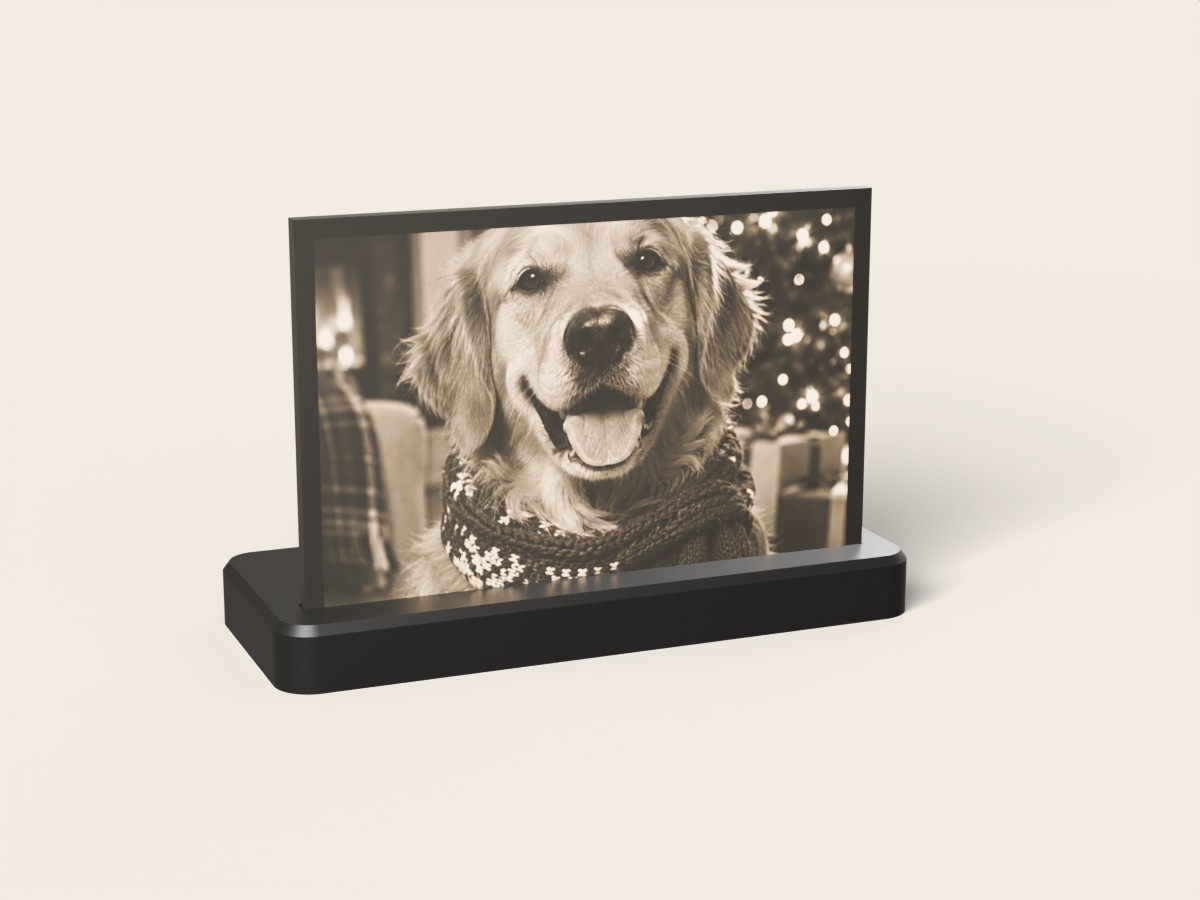 Photo giftsCustom photo lithophane lampFits any photo you send (landscape crops best)
Questions
Is it better to print a lithophane flat or vertical?
Vertical. Standing up, the thickness of the panel is set by the printer's side-to-side movement, which is very fine, so the shading is smooth. Lying flat, the thickness can only change one whole layer at a time, which shows as steps in faces and skies.
When should a lithophane be printed flat?
In three cases: colour lithophanes, because the colour layers have to sit behind the whole picture; very small pieces such as keychains, where steps are hard to see; and panels too tall to stand on the printer.
What layer height should a flat lithophane use?
The thinnest the printer can do reliably, usually 0.08 mm with a 0.4 mm nozzle. A flat lithophane makes every shade out of whole layers, so thinner layers mean more shades.
How do you stop a vertical lithophane from wobbling or falling over?
Add a brim of 5 to 10 mm, slow the outer walls to about 30 to 40 mm/s, and turn the panel so it runs along the direction the bed moves. A curved panel stands much more firmly than a flat one.